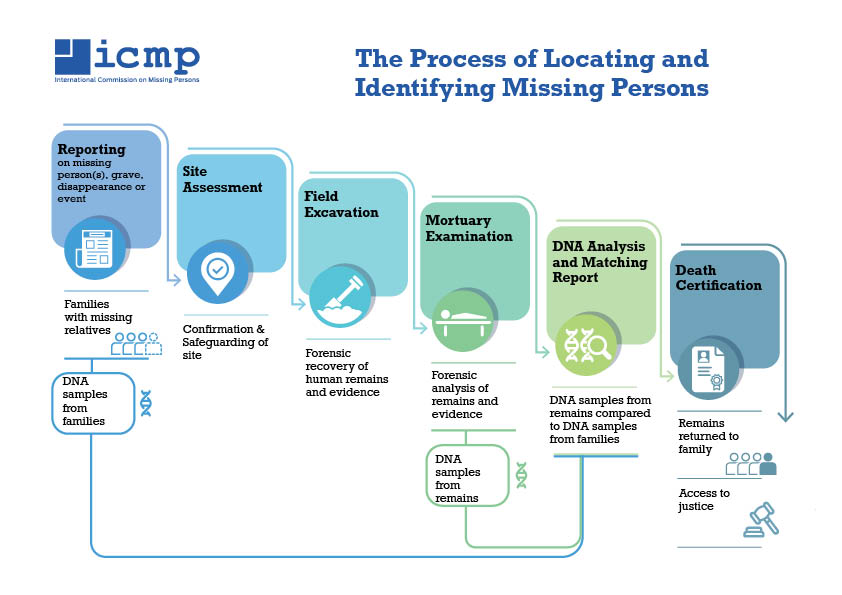
Reporting a missing person
Who is a missing person?
Subjectively, a missing person is anyone whose whereabouts are not known and who is being sought by another person or other persons. The term “missing person” acquires an objective meaning when a person is formally reported as missing, or when an unidentified body is discovered.
How is a missing person reported?
The method of reporting a missing person depends on the context, for example the location and history of the person or persons. Sometimes, people proactively report a missing family member to the authorities. At other times, the authorities may engage a group or a community and encourage them to report missing relatives.
Reference sample collection
What is a reference sample?
A reference sample is usually a blood sample or cheek (saliva) swab from the relative of a missing person. A reference sample contains the DNA of the provider, which can then be compared with DNA from unidentified human remains, or unidentified children or others who may not be able to identify themselves.
How are reference samples collected?
Typically, the authorities and/or other public agencies or independent organizations will collect reference samples from families of the missing. Simple, user-friendly kits can be used to collect blood or saliva samples.
Samples may be collected through local campaigns, usually targeting a specific group of people or community. For a broader sampling area, reference kits can be distributed and collected by mail.
Field operations
Field operations focus on locating, assessing, safeguarding, and excavating a site presumed to be a mass grave. Sites can be identified through witness reports, aerial imagery, and archeological investigation.
Site of forensic interest: desk-based assessment
Information surrounding a specific site can be collected using different tools and techniques, such as Geographic Information System (GIS) mapping technology. Local knowledge and historical context will also be taken into consideration to provide investigative teams with background information on the area and what may have happened there.
Site assessment and safeguarding
When a site has been located or reported, a team will deploy to determine if it is of forensic interest. The investigating team will record different attributes of the site, such as location, landscape details, and health and safety risks that may be present at the site. The team will use specialized tools and visual assessments for this.
The team will take steps to safeguard the site from interference, which may include fencing the perimeter of the grave, or protection of any surface lying remains.
Field excavation
Once an assessment of the site has been performed, excavation will begin. When forensic specialists excavate a site, they not only support the removal of bodies but also study the geological profile of the grave to determine, for example, how old the grave is and the likely identity of the human remains. They will also collect artifacts. Human remains from the site will be transferred to a mortuary for examination.
Examination
Mortuary examination is designed to reveal more about the person and the circumstances of death. Attributes such as age, sex, and distinguishing characteristics may be determined. It may also be possible to determine the cause of death. To assist identification, a DNA sample will be extracted and sent for analysis.
DNA Analysis: testing and matching
A DNA profile from the human remains is compared with DNA profiles from reference samples provided by families of missing persons. If a match is found, this information will be sent to the investigative authority in charge of confirming identifications.
Identification and issue of death certificate
When a DNA match has been found, identification is confirmed by a legal authority. This authority or institution will evaluate all the available evidence – missing persons report, reference samples and ante-mortem data, field operations, examination, and DNA Match report. When a positive identification is confirmed, a death certificate is issued and the family is informed.
Human remains returned to family
After an authority has confirmed an identification and issued a death certificate, the remains of the missing person are returned to the family for burial and memorialization. This not only provides closure for families: it may open the way for them to access their rights to justice and reparations.